June 10 2026 | Deals | M&A Advisors | Europe | Investment Banking
Key takeaways: Europe IT services M&A in 2026
- Deal volumes are set to rise. Greater risk appetite, abundant dry powder, and growing pressure to deploy capital are expected to drive increased transaction activity — particularly in the €100 million to €1 billion range.
- The market is binary. Assets with recurring revenue and downside protection command extraordinarily high multiples. Less resilient businesses struggle to attract interest at all.
- International scale is now a prerequisite. Customers are actively reducing supplier complexity and demanding 24/7 global support from a single source, putting pressure on service providers to build cross-border reach through acquisition.
- Managed services and cybersecurity remain premium assets. Three years of strong performance despite macroeconomic headwinds has cemented their status as the most sought-after targets in the sector.
- AI is accelerating the deal process itself. Buyers and advisors are using AI to compress sector-mapping and competitive intelligence work that previously required weeks of expert interviews.
"It's a really binary market — either everyone loves the business and that's reflected in high valuations, or it's not trading."
What is driving the expected uptick in IT services M&A activity in 2026?
After a prolonged period of caution, the conditions for a more active deal environment are falling into place. According to Malte Abrams, Managing Director and Head of IT Services for Europe at Houlihan Lokey, markets have gradually adapted to volatile macroeconomic conditions — and investors are running out of runway to keep capital on the sidelines.
"We expect to see higher valuations, more aggressive deal activity, and greater deal flow than before, if that occurs," Abrams says, pointing to potential interest rate reductions as a key catalyst. The sweet spot for activity is expected to be the mid-market, with deals most plentiful in the €100 million to €1 billion range.
The pressure to invest is as much structural as it is cyclical. Private equity funds with significant dry powder need to manufacture growth where organic options have plateaued, and that means acquisition — at pace.
Why is the IT services market becoming so polarised on valuations?
The divergence Abrams describes is stark. Businesses with recurring revenue streams, strong retention, and what he terms "crisis-resilient" characteristics are attracting intense competition from both private equity and trade buyers, pushing multiples to extraordinary levels. Everything else is largely sitting still.
"It's a really binary market — either everyone loves the business and that's reflected in high valuations, or it's not trading," he says.
Managed services and cybersecurity businesses have been the primary beneficiaries of this dynamic, maintaining strong performance for three consecutive years despite difficult macro conditions. Their appeal is straightforward: predictable revenue, mission-critical relationships, and structural tailwinds that show no sign of reversing.
What is driving consolidation and international expansion in IT services?
Customer behaviour is the primary force reshaping the competitive landscape. As IT infrastructure grows in complexity, large organisations are actively reducing the number of suppliers they work with — seeking instead to consolidate around partners capable of delivering 24/7 uptime, high response rates, and rigorous cybersecurity from a single source.
"The more international the customers, the more they'll look to deal with international suppliers," Abrams says. "Because of the complexity of IT infrastructure today, businesses are actively looking to avoid supplier-side complexity. They want 24/7 uptime, high speed, high response rates, and rigorous cybersecurity, and they want all that from a single source to avoid friction within the supplier landscape."
That dynamic is accelerating both pan-European and global consolidation. Large players are acquiring delivery centres in lower-cost markets to manage margin pressure, while simultaneously building the breadth of capability needed to win and retain enterprise clients.
Which IT services segments are attracting the most investor interest?
Beyond managed services and cybersecurity, Abrams identifies data analytics and AI services companies as a growing focus for investors. Typically founded three to five years ago, these businesses have established product-market fit but now require capital to scale — making them attractive acquisition targets for larger platforms looking to add technical depth quickly.
There is also emerging interest in circular economy businesses offering IT refurbishment and recycling services, as customers face increasing pressure to demonstrate progress against sustainability targets.
"That's due to demand from private equity funds and from trade buyers that need to accelerate their growth via acquisition because organic growth has slowed," Abrams notes.
How is AI changing the M&A process in IT services?
AI is already compressing the timeline of the deal process itself, particularly in the early stages of sector mapping and competitive intelligence. Work that previously required extensive rounds of expert interviews can now be done faster and at greater breadth using AI tools.
"Where people might previously have needed 10 or 15 expert interviews, they can now turn to AI for information about a business and its competitors and the market at large," Abrams says.
For advisors and buyers operating across multiple geographies simultaneously, this acceleration matters. As cross-border transactions become the norm rather than the exception, the ability to get up to speed on unfamiliar markets quickly is a meaningful competitive advantage.
What does the outlook mean for mid-market IT services businesses?
The strategic imperative for mid-market players is increasingly clear: scale or be acquired. Clients are pruning their supplier lists in favour of large, integrated partners with global delivery capability, and the window for building that scale organically is narrowing.
For businesses that can demonstrate recurring revenue, crisis resilience, and a credible international growth story, the valuation environment is as favourable as it has been in years. For those that cannot, the gap is widening.
Success in 2026 will go to those who:
- Build or acquire the international delivery infrastructure needed to serve global clients
- Demonstrate recurring, contractually protected revenue streams that hold up under pressure
- Move quickly — AI-assisted deal processes are compressing timelines, and hesitation is increasingly costly
Frequently asked questions
What types of IT services businesses are attracting the highest valuations in 2026?
Managed services and cybersecurity businesses with strong recurring revenue and demonstrable resilience during economic downturns are commanding the highest multiples. Data analytics and AI services firms with established product-market fit are also attracting significant interest.
Why are IT services businesses consolidating internationally?
Large customers are seeking to reduce supplier complexity and demand 24/7 global support from single, integrated partners. This is pushing IT services providers to acquire delivery capability across geographies, particularly in lower-cost markets, to remain competitive for enterprise contracts.
What deal sizes are most active in European IT services M&A?
Activity is expected to be most concentrated in the €100 million to €1 billion range, though transactions will occur across all market levels.
How is AI being used in IT services M&A transactions?
AI is primarily being used in the pre-deal phase to accelerate sector mapping, competitive benchmarking, and market intelligence — work that previously required extensive expert interview programmes. This is compressing deal timelines, particularly for cross-border transactions.
What happens to mid-market IT services businesses that don't consolidate?
As enterprise clients consolidate around large, globally capable suppliers, mid-market businesses without international scale or deep specialisation face increasing difficulty winning and retaining major contracts. The pressure to consolidate or be acquired is intensifying.
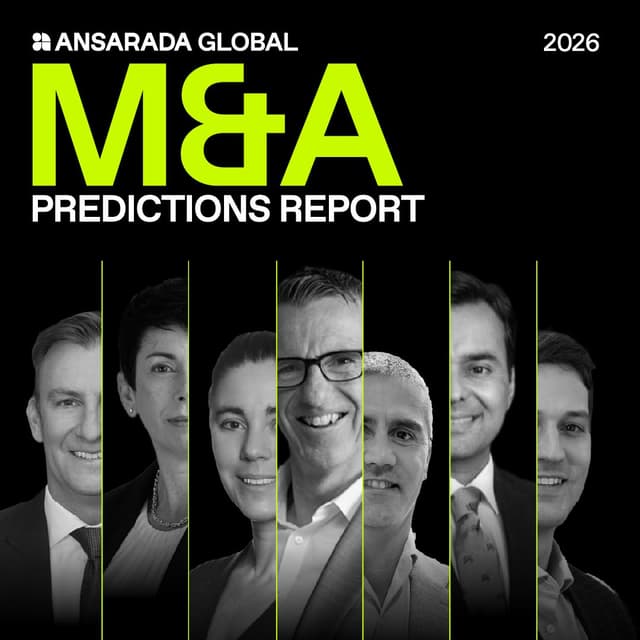
Get the complete global M&A outlook
Download the full 2026 Global M&A Predictions Report, featuring insights from 26 dealmakers across seven regions.