


March 8 2026 | Deals | Virtual Data Rooms
Part I: The history and evolution of virtual data rooms
To understand the modern VDR, one must analyse the trajectory of deal-making logistics. The evolution of the data room is not merely a technological history; it is a history of transaction velocity and risk mitigation.
1.1 The era of physical data rooms (1980s – 1990s)
Prior to the digital revolution, the "data room" was a literal, physical location — typically a secure conference room within the seller’s law firm or corporate headquarters. This era, characterising the M&A boom of the 1980s, was defined by extreme logistical friction and high operational costs.
Logistical constraints and information asymmetry of physical data rooms
In a physical data room environment, due diligence was a linear and exclusionary process. Because the documents existed in physical binders, often only one potential buyer team could access the room at a time. This created a forced schedule where Bidder A might review documents in week one, and Bidder B in week two, extending deal timelines by months.
- Access control: Access was controlled by human security guards and physical logbooks. Auditors and lawyers had to fly to the location, incurring significant travel and accommodation costs.
- Security risks: Despite physical security, the risk of data leakage was substantial. Documents could be photocopied, photographed, or even physically removed from the premises if oversight lapsed. Furthermore, if a new document was added to the diligence pile, it had to be physically couriered to the room and filed, alerting all parties to its arrival.
1.2 The transition from physical to digital: The fallacy of FTP and email
As the internet boom of the late 1990s accelerated business, companies attempted to digitise diligence using standard tools: email and File Transfer Protocol (FTP) servers. While this solved the travel requirement, it introduced catastrophic security vulnerabilities.
- Lack of control: Once a file was emailed or downloaded from an FTP server, the seller lost all control over it. There was no way to prevent the recipient from forwarding the file to unauthorized parties, printing it, or saving it to an insecure drive.
- Version control chaos: Managing versioning via email resulted in disjointed diligence, where different bidders might be reviewing different versions of a financial statement, leading to valuation errors and legal disputes.
1.3 The rise of the SaaS VDR (2000 – 2020)
The modern virtual data room emerged in the early 2000s as a specialised Software-as-a-Service (SaaS) solution designed to combine the accessibility of the internet with the security of a physical vault.
- Simultaneity: The defining economic breakthrough of the VDR was simultaneity. Multiple bidder groups could review the same documents at the same time without knowing of each other's presence. This allowed sellers to run competitive auctions with tighter timelines, driving up deal value.
- Global reach: Globalisation of M&A meant that a buyer in London could review assets in Tokyo without leaving their office. This expanded the pool of potential acquirers, further increasing asset liquidity.
1.4 The AI and workflow era (2025 – Future)
By 2025, the virtual data room market had matured into a sophisticated ecosystem where "storage" is a commodity and "workflow" is the differentiator. The integration of Artificial Intelligence (AI) and Machine Learning (ML) has transformed VDRs into active participants in the deal process.
- Predictive analytics: Modern platforms like Ansarada and Datasite utilise behavioral analytics to predict deal outcomes. By analysing how much time a specific bidder spends in the "Financials" folder versus the "Legal" folder, the system can gauge their level of interest and potential concerns.
- Generative AI integration: VDRs now incorporate LLMs to perform automated redaction of Personally Identifiable Information (PII) and to answer natural language queries about the document corpus (e.g., "Show me all contracts with change-of-control clauses").
Part II: Technical architecture and security mechanics
2.1 Infrastructure and compliance certifications
The foundation of VDR security lies in its hosting environment. Leading providers typically utilise top-tier cloud infrastructure (such as AWS, Microsoft Azure, or private colocation facilities) that adheres to strict physical and digital security standards.
Certification
Relevance to VDR
ISO 27001
International standard for Information Security Management Systems (ISMS).
Demonstrates a systematic approach to managing sensitive company information so that it remains secure.
ISO/IEC 42001
This framework covers AI governance, risk and impact assessments, transparency, explainability, privacy, bias management, and continuous monitoring.
If A VDR is using AI they should be aligned with ISO/IEC 42001. Only two providers are currently aligned withISO/IEC 42001 - Datasite and Ansarada.
SOC
Service Organisation Control 2, Type II reports on a service organisation's controls relevant to security, availability, processing integrity, confidentiality, and privacy over a period of time (usually 6-12 months).
This is the gold standard for VDRs. Unlike Type I (point in time), Type II proves consistent security practices. While ISO qualifications are higher than SOC 2
HIPAA
Health Insurance Portability and Accountability Act.
Mandatory for VDRs used in biotech, pharma, and healthcare deals where Protected Health Information (PHI) is present.
GDPR / CCPA
General Data Protection Regulation (EU) / California Consumer Privacy Act (US).
Critical for cross-border deals. VDRs must offer Data Residency options, allowing clients to choose specifically where their data is hosted (e.g., servers located physically within Germany).
FedRAMP
Federal Risk and Authorisation Management Program.
Required for VDRs handling US government data or defense contracts.
2.2 Encryption standards: At rest and in transit
Virtual data rooms employ advanced encryption to ensure that data is unreadable to unauthorised parties, including the cloud provider itself.
- Encryption in transit: All data moving between the user's browser and the VDR servers must be encrypted using TLS 1.3 (Transport Layer Security) protocol. This prevents "man-in-the-middle" attacks where an attacker intercepts the data stream.18
- Encryption at rest: Files stored on the server are encrypted using AES-256 (Advanced Encryption Standard 256-bit). This is the same standard used by financial institutions and the military. Even if a hacker were to physically steal the hard drive from the data center, the data would remain mathematically inaccessible without the decryption keys.15
2.3 Digital Rights Management (DRM) and Information Rights Management (IRM)
This is the core differentiator between virtual data roomsand a standard cloud storage solution like Dropbox or Google Drive. VDRs apply security settings to the document itself, not just the folder it resides in.
Remote shredding (retroactive access revocation)
Remote shredding allows an administrator to revoke access to a document after it has been downloaded and saved to a user’s local device.
- Mechanism: When a user downloads a document from a VDR, it is often wrapped in an encrypted "shell" (often a specialised PDF or secure viewer). To open the document, the user's computer must ping the VDR server to verify their credentials. If the administrator has disabled that user's access (e.g., because the deal is over or the bidder was eliminated), the server denies the request, and the document will not open, effectively "shredding" it digitally.
Dynamic watermarking
Static watermarks (e.g., a "CONFIDENTIAL" stamp) are ineffective because they can be easily cropped out. Dynamic Watermarking automatically overlays unique, session-specific information onto the document when it is viewed or printed.
- Data points: The watermark typically includes the User’s Name, User’s Email Address, IP Address, and the Date/Time Stamp.
- Psychological deterrence: This serves as a powerful psychological deterrent against leaks. If a user takes a photo of their screen or prints a document and leaves it in a public place, the leak can be traced back to them instantly. This feature is cited as one of the most critical for preventing unauthorised distribution.23
Fence view (spotlight view)
For documents of extreme sensitivity (e.g., employee salary lists, unpatented IP), VDRs offer a "Fence View" or "Spotlight" mode.
- Function: This feature obscures the entire document with a digital pattern (fence), allowing the user to reveal only a small horizontal bar of text where their mouse is hovering. This prevents users from taking screenshots of the full page and makes "over-the-shoulder" spying impossible.
2.4 Granular access control and granularity
Security in a VDR is not binary (access vs. no access). It is granular. Administrators can set permissions at the User, Group, and Folder/File levels.
- Permission levels:
- None: User cannot see the folder exists.
- View: User can view the document in the secure browser viewer only.
- Download (PDF): User can download a watermarked PDF.
- Download (Original): User can download the native file (e.g., Excel with formulas).
- Edit/Upload: User can modify files (typically reserved for the sell-side team).
- Advanced remote doc destruct: Administrators can destruct documents no matter where they are downloaded - Ansarada is only provider to offer this without Plug-ins (Plug-ins are often blocked by Corporations internal systems)
- Negative permissions: A key feature is the ability to hide specific sub-folders from specific groups. For example, the "Human Resources" folder containing individual salaries might be visible to the Buyer's HR consultant but hidden from the Buyer's operational team to prevent internal culture clashes post-merger.
2.5 The audit trail: Forensics and liability
A comprehensive audit trail is the "black box" of the deal. It records every interaction within the data room: logins, views, prints, downloads, and search queries.
- Legal utility: In the event of a post-closing dispute, the audit trail serves as the definitive record of disclosure. If a buyer claims, "We were not aware of this pending litigation," the seller can produce the audit log showing that the buyer’s legal counsel viewed the "Litigation_Update.pdf" on a specific date for 12 minutes. This transparency protects sellers from indemnity claims.
- Deal intelligence: For the sell-side investment bankers, the audit trail provides real-time feedback on bidder interest. If a bidder spends 80% of their time in the "Environmental Liabilities" folder, the banker knows this is a key concern and can prepare to address it in the next management presentation. Ansarada has advanced Ai-features to predict who will be the winning buyer/Bidder with 97% accuracy.
Part III: The VDR market landscape and vendor analysis (2025-2026) The top VDRs
The VDR market is segmented by deal size, industry focus, and pricing model. Choosing the right provider is a strategic decision that impacts the cost and efficiency of the deal.
3.1 The 2026 virtual data room comparative analysis of market leaders
The following analysis categorises the top providers based on their 2025-2026 market positioning, feature sets, and user feedback.
Group A: M&A VDR the three giants
These providers serve the top tier of the market and mid-market (Bulge Bracket banks, Fortune 500 M&A).
- Ansarada
Core strength: AI-driven data rooms. Fast deployment; The only self-service virtual data room, voted on G2 best designed UI and easiest to use. AI features and analytics
Pricing: Online ecommerce and Megabyte/ transaction fee
Use case: M&A Full lifecycle from free prep, Due Diligence to integration - Multi language. Capital raising, IPO, restructure, audits, Infrastructure Procurement
API integrations: Grata, Harvey, Legora, Jurimesh
Ansarada founded: APAC
Ansarada supports MCP (Model Context Protocol), enabling AI assistants to connect directly to the document index at a read-only level. Contact us to find out more .
What users say about Ansarada
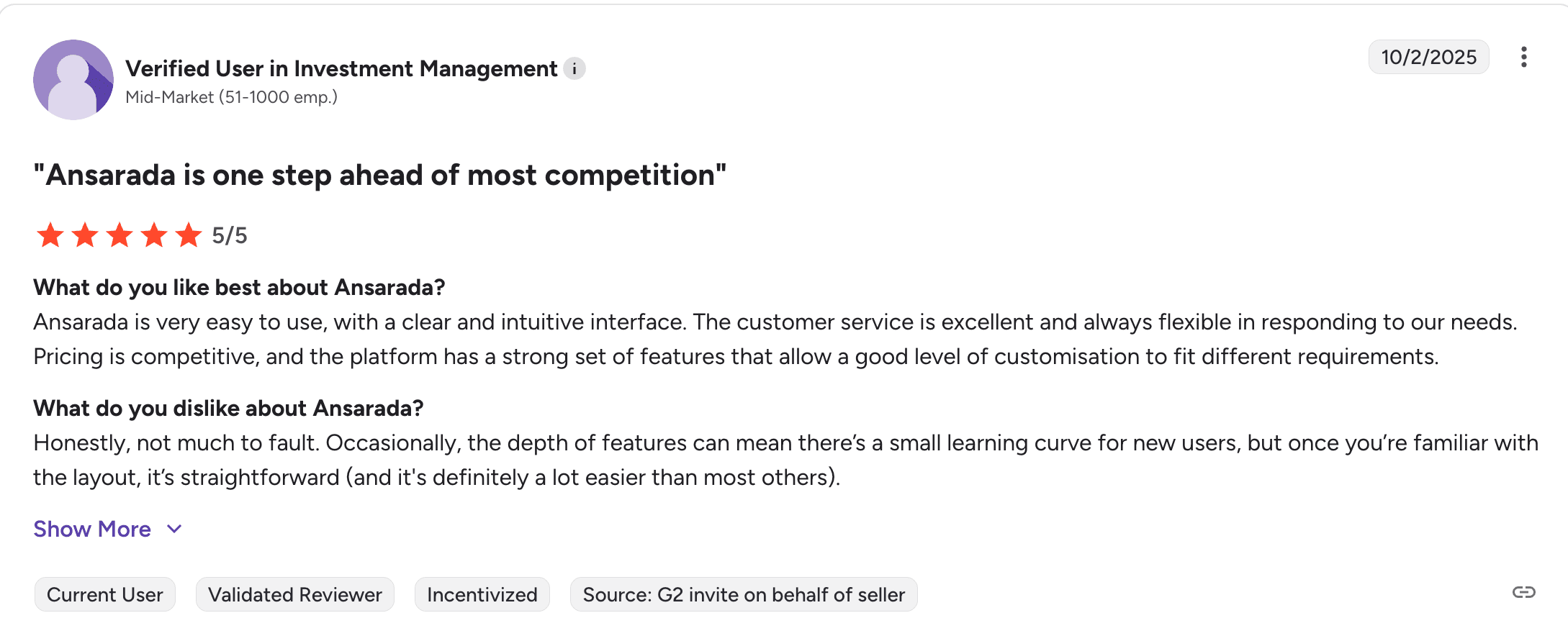
Customer review: "Ansarada is one step ahead of most competition"
G2 user: Verified User in Investment Management. Mid-Market (51-1000 emр.)
Ansarada Score: 5/5
What do you like best about Ansarada?
"Ansarada is very easy to use, with a clear and intuitive interface. The customer service is excellent and always flexible in responding to our needs. Pricing is competitive, and the platform has a strong set of features that allow a good level of customisation to fit different requirements."
What do you dislike about Ansarada?
"Honestly, not much to fault. Occasionally, the depth of features can mean there’s a small learning curve for new users, but once you’re familiar with the layout, it’s straightforward (and it's definitely a lot easier than most others)."
Ansarada customer review
Customer review: "(Ansarada) Effortless Setup and Outstanding Support"
G2 user: Hamish M. Manager, Enterprise (> 1000 eтр.)
Ansarada Score: 5/5
What do you like best about Ansarada?
"(Ansarada) It's an easy to use platform with a logical Ul and the Ansarada team is always there to help. It's easy to set up new data rooms and for new users to navigate."
What do you dislike about Ansarada?
"Not much, although I am interested to see how the integration of Al will develop on the platform."
Ansarada G2 Review
Try Ansarada for free
Start now and bring order to your deal management
2. Datasite
Core Strength: M&A lifecycle
Pricing: Per-page / Transaction Fee
Use case: M&A Full lifecycle from prep to integration. Multi language
API integrations: Grata, BlueFlame Ai
Datasite founded: USA
What users say about Datasite Diligence
Customer review: "(Datasite) Clear, fast data management"
G2 user: Patrick W.
Datasite Score: 5/5
What do you like best about Datasite Diligence?
"I find the clarity of Datasite Diligence Virtual Data Room great. You quickly get an overview of which data has been newly uploaded, what is new in the Q&A section, and that is very advantageous and practical. It is simply structured compared to other data room providers, which makes it easier to add and remove new data."
What do you dislike about Datasite Diligence?
"Yes, I mean, it probably can't be changed on a data protection basis, but it's always necessary to renew your password, which can be a bit annoying from time to time. But otherwise, yes, maybe what could be improved is to display the Q-and-A process faster, showing what has been resolved, which Q-and-As have been fully answered, and which have not."
2. Intralinks
Core Strength: M&A
Pricing: Per-page / High Transaction Fee
Use case: M&A
Intralinks founded: USA
What users say about Intralinks
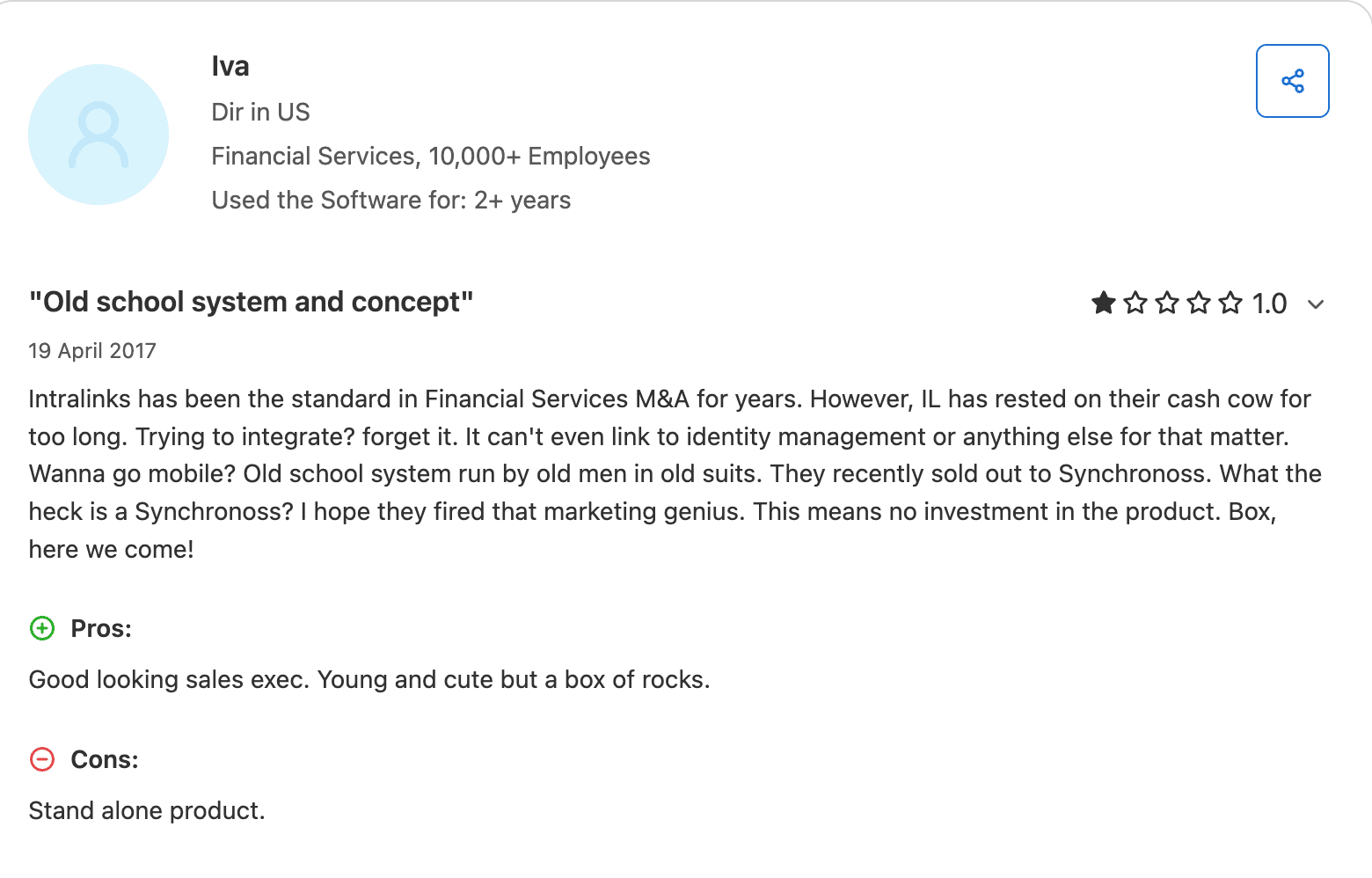
Intralinks Customer review: "Old school system and concept" Capterra user: Iva, Dir in US, Financial Services, 10,000+ Employees Intralinks Score: 1/5
What do you dislike about Intralinks Diligence?
Intralinks has been the standard in Financial Services M&A for years. However, IL has rested on their cash cow for too long. Trying to integrate? forget it. It can't even link to identity management or anything else for that matter. Wanna go mobile? Old school system run by old men in old suits. They recently sold out to Synchronoss. What the heck is a Synchronoss? I hope they fired that marketing genius. This means no investment in the product. Box, here we come!
Pros: Good looking sales exec. Young and cute but a box of rocks.
Cons: Stand alone product.
What do you dislike about Intralinks Diligence?
Good looking sales exec. Young and cute but a box of rocks.
Intralinks customer review
Group B: Datarooms for the SME and mid-market
These providers focus on speed, ease of use, and transparent pricing. They are favored by Private Equity, Mid-Market Investment Banks, and Mid-marketCorporate Development teams.
SME and mid-market Providers:
3. Ansarada Essentials By Datasite
(Available pricing for Small to medium enterprises)
Ansarada Essentials core strength: Virtual Data rooms for due diligence for the SME and Mid-market, Fundraising, SMB Sales.
Ansarada Essentials Pricing: Affordable online pricing and Megabyte/ Transaction Fee
Ansarada Essentials use case: M&A, Capital raising, IPO, restructure, audits
Ansarada founded: APAC
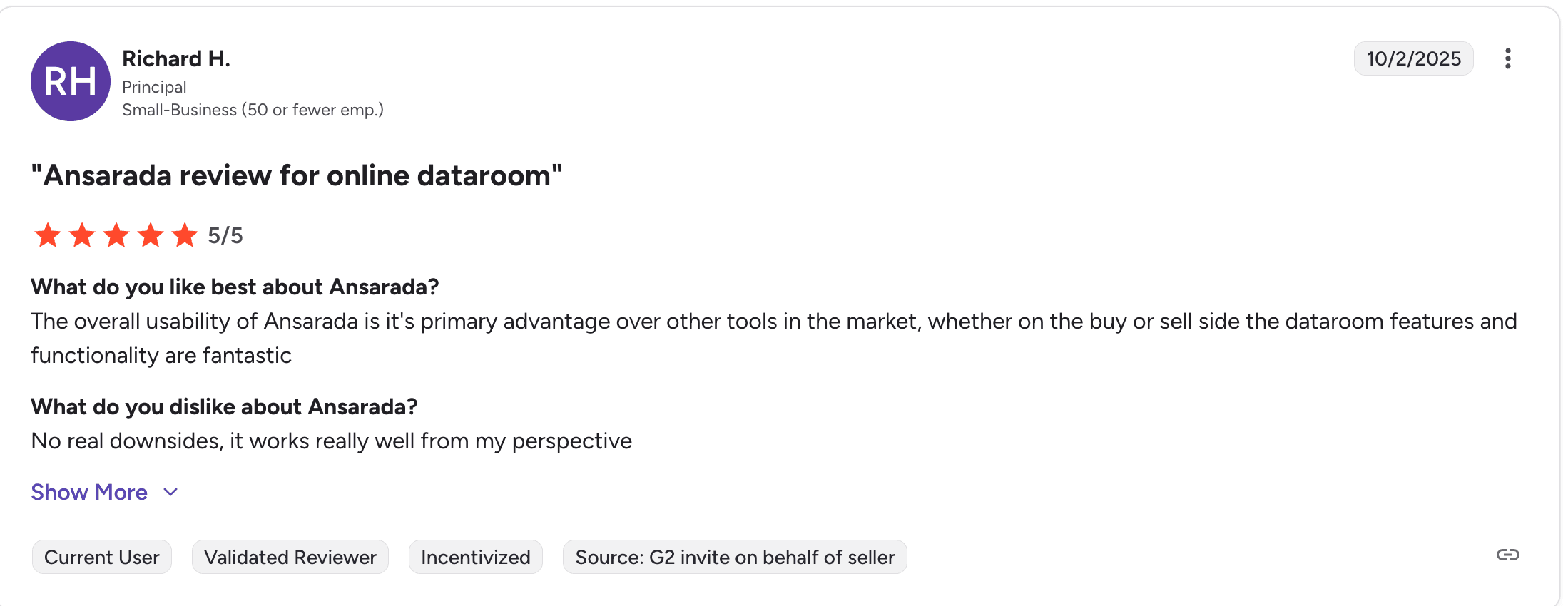
Ansarada Customer review "Ansarada review for online dataroom"
G2 user: Richard H., Principal Small-Business (50 or fewer emp.)
G2 user Ansarada score: 5/5 What do you like best about Ansarada?
"The overall usability of Ansarada is it's primary advantage over other tools in the market, whether on the buy or sell side the dataroom features and functionality are fantastic."
What do you dislike about Ansarada?
"No real downsides, it works really well from my perspective."
Ansarada essentials review
4. SecureDocs
SecureDocs core strength: File storage
Pricing: Monthly flat rate
Use case: File storage, Fundraising, SMB Sales, IP Licensing.
SecureDocs founded: USA
SecureDocs customer review SecureDocs customer review: "Easy Setup, Strong Security Yet Dated Interface"
G2 User: Jaime S., Small-Business (50 or fewer emp.) G2 user SecureDocs score: 3.5/5
What do you like best about SecureDocs Virtual Data Room, an Onit Product?
I like SecureDocs Virtual Data Room because it's easy to set up and has strong security features. This gives me confidence that sensitive information is secure.Review collected by and hosted on G2.com.
What do you dislike about SecureDocs Virtual Data Room, an Onit Product?
Some parts of the interface feel dated.

SecureDocs customer reveiw
5. iDeals VDR
Ideals core strength: Basic VDR and file storage
Pricing: per User and GB Tiered Subscription
Use case: File storage, Fundraising
iDeals Founded: Eastern Europe
Ideals VDR customer reviews
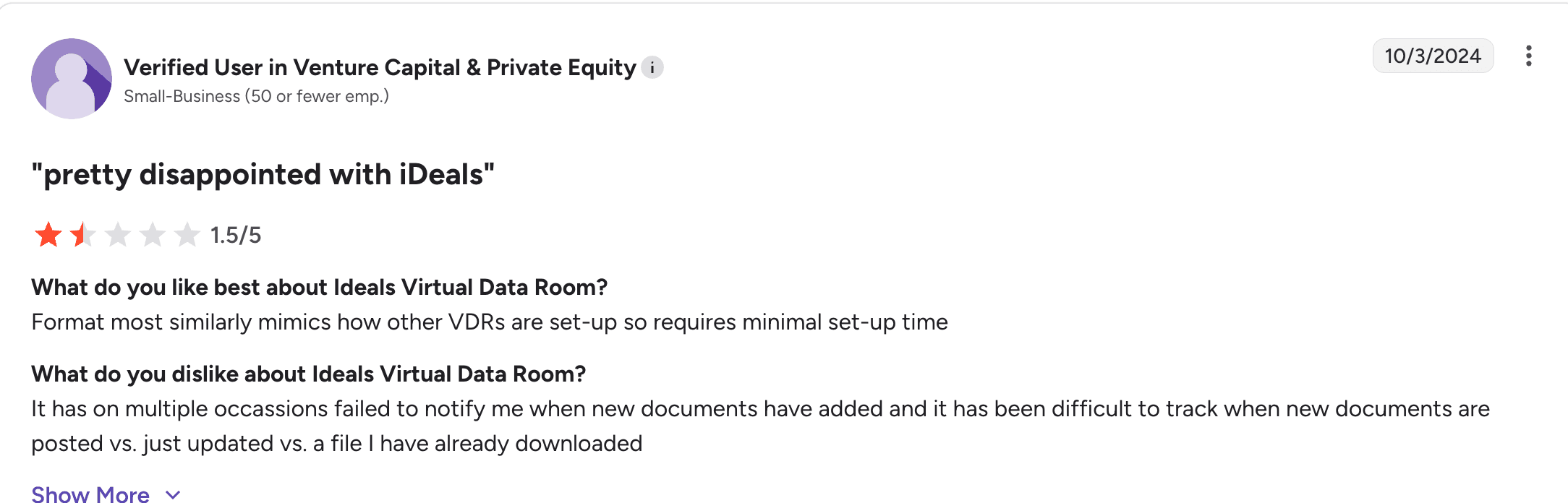
G2 Ideals VDR customer "pretty disappointed with iDeals"
G2 Verified User: Venture Capital & Private Equity i Small-Business (50 or fewer emp.)
G2 user Ideals VDR score:1.5/5
What do you like best about Ideals Virtual Data Room?
Format most similarly mimics how other VDRs are set-up so requires minimal set-up time
What do you dislike about Ideals Virtual Data Room?
It has on multiple occassions failed to notify me when new documents have added and it has been difficult to track when new documents are posted vs. just updated vs. a file I have already downloaded
Ideals G2 Customer review
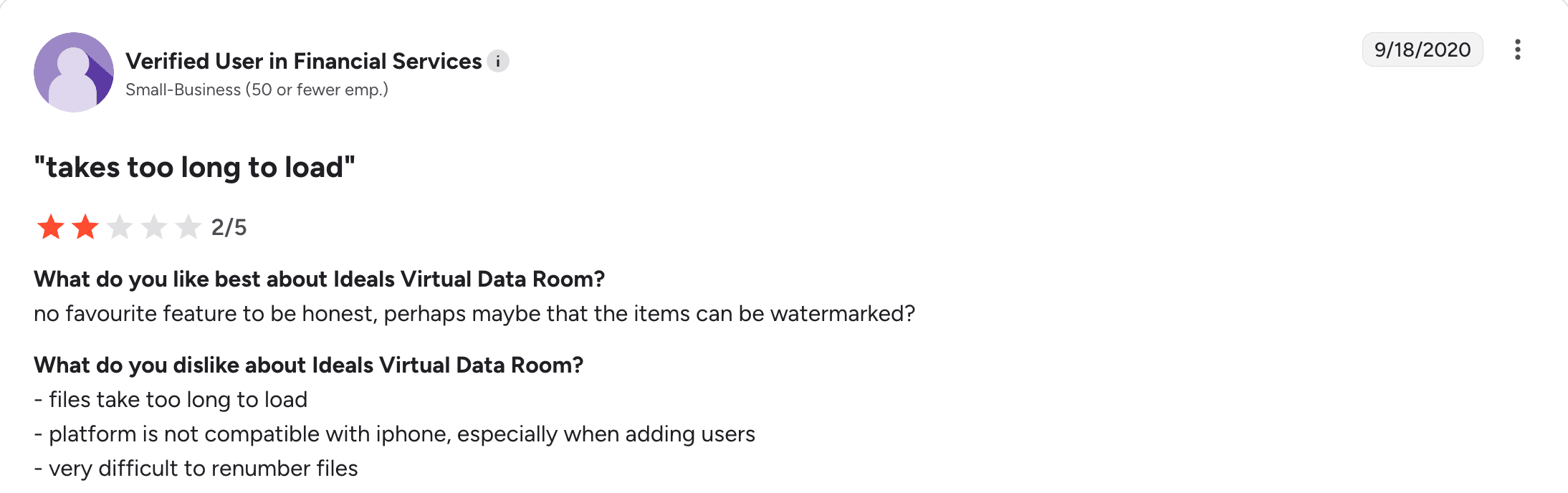
Ideals VDR customer review "(Ideals) takes too long to load"
G2 Verified User: Financial Services Small-Business (50 or fewer emp.)
G2 user Ideals VDR score: 2/5
What do you like best about Ideals Virtual Data Room?
no favourite feature to be honest, perhaps maybe that the items can be watermarked?
What do you dislike about Ideals Virtual Data Room?
- files take too long to load
- platform is not compatible with iphone, especially when adding users
- very difficult to renumber
G2 Ideals customer review
6. Caplinked
Caplinked core strength: Basic VDR and file storage
Pricing: per User and GB Tiered Subscription
Use case: Basic functionality
Caplinked Founded: USA
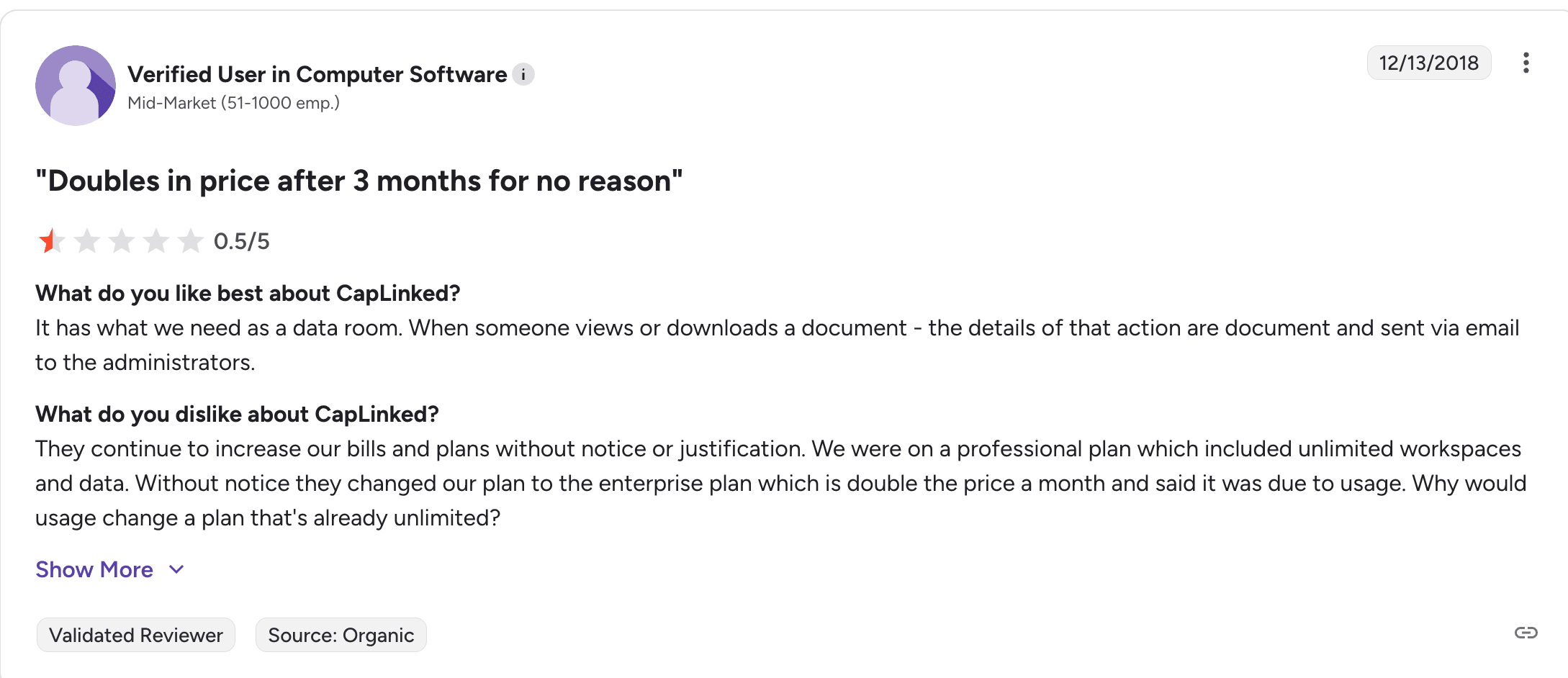
Caplinked customer reviews G2 Caplinked customer review: "Doubles in price after 3 months for no reason"
G2 Verified User: Computer SoftwareMid-Market (51-1000 emp.)12/13/2018 G2 user Caplinked score:.5/5
What do you like best about CapLinked?
"It has what we need as a data room. When someone views or downloads a document - the details of that action are document and sent via email to the administrators."
What do you dislike about CapLinked?
"They continue to increase our bills and plans without notice or justification. We were on a professional plan which included unlimited workspaces and data. Without notice they changed our plan to the enterprise plan which is double the price a month and said it was due to usage. Why would usage change a plan that's already unlimited?"
Caplinked customer review
7. DealRoom
Caplinked core strength: Buyside M&A
Pricing: per User and GB Tiered Subscription
Use case: Combines VDR with Project Management (Kanban boards) to track diligence tasks.
Founded: USA
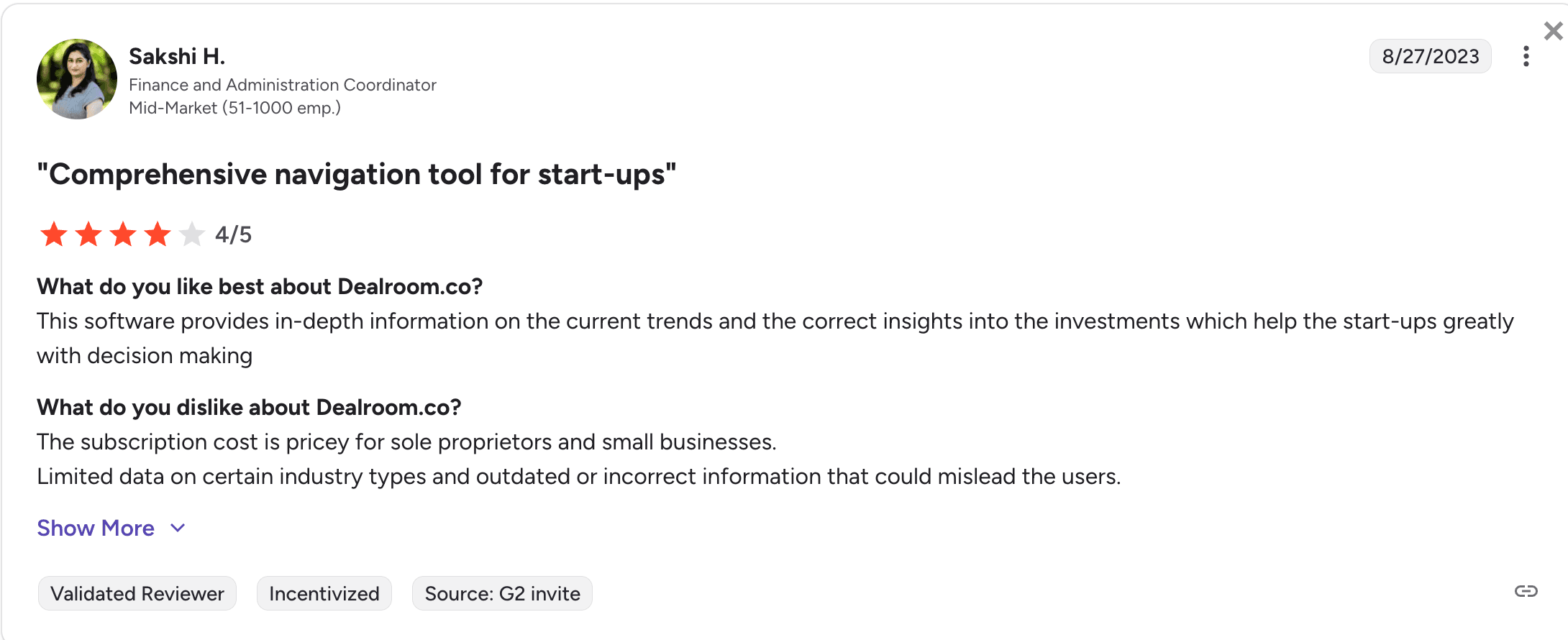
Dealroom customer reviews Dealroom customer reviews: "Comprehensive navigation tool for start-ups"
G2 Verified User: Sakshi H.Finance and Administration CoordinatorMid-Market (51-1000 emp.) G2 user Dealroom score:.4/5
What do you like best about Dealroom.co?
This software provides in-depth information on the current trends and the correct insights into the investments which help the start-ups greatly with decision makingReview collected by and hosted on G2.com.
What do you dislike about Dealroom.co?
The subscription cost is pricey for sole proprietors and small businesses.
Limited data on certain industry types and outdated or incorrect information that could mislead the users.
Dealroom.co Customer review
8. Digify
Digify core strength: Document storage
Pricing: GB Transaction fee
Use case: Focuses on securing individual files sent via email links; excellent for start-ups, and pitch decks.
Digify founded: Singapore
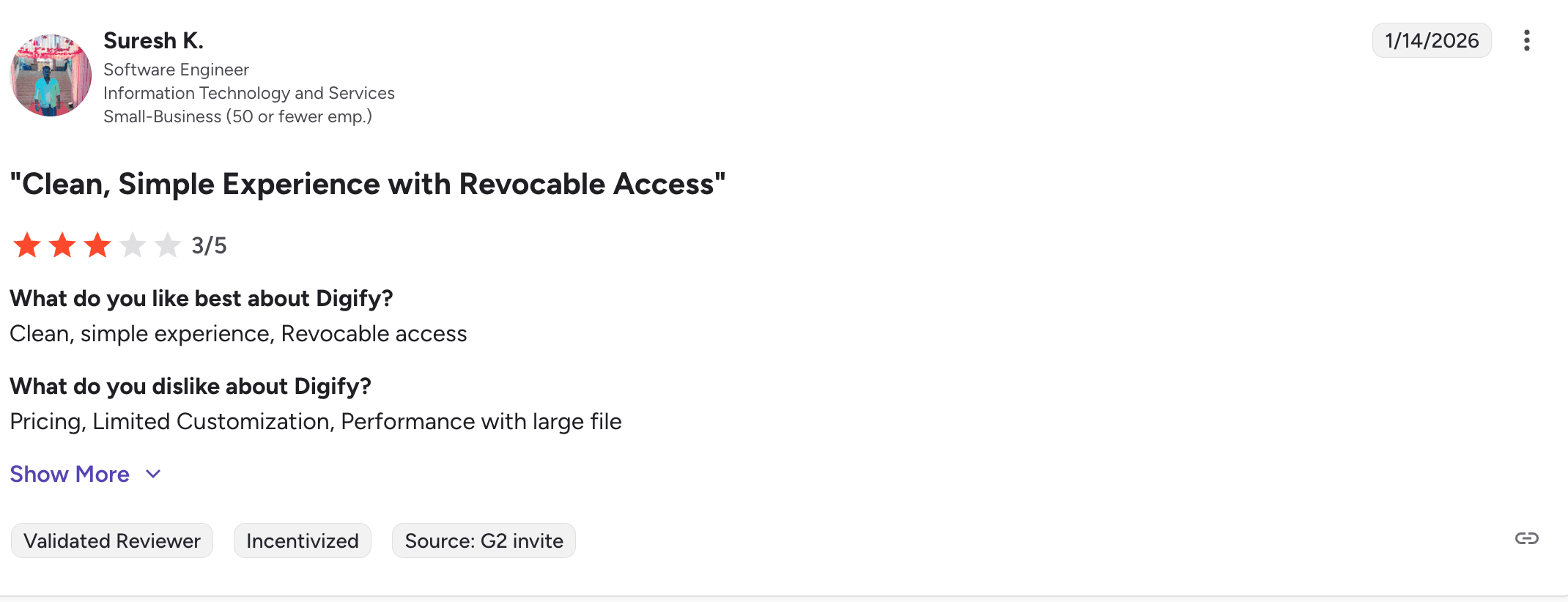
Digify customer reviews: (Clean, Simple Experience with Revocable Access)
G2 Verified User: Suresh K.Software Engineer, Information Technology and Services Small-Business G2 user Digify score: 3/5
What do you like best about Digify?
Clean, simple experience, Revocable access
What do you dislike about Digify?
Pricing, Limited Customization, Performance with large file
Digify Customer review
9. Sharevault Sharevault core strength: Document storage
Pricing: GB Transaction fee
Use case: Focuses on securing individual files sent via email links; excellent for start-ups, and pitch decks.
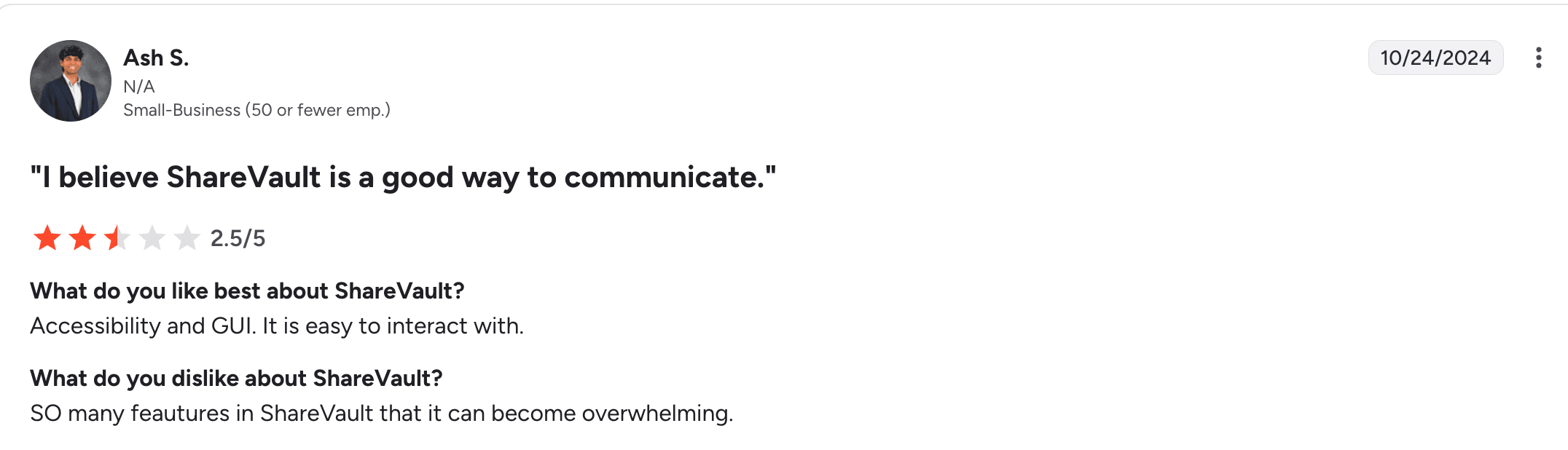
Sharevault founded: USA G2 Verified User: Ash S.N/ASmall-Business (50 or fewer emp.)
G2 user Sharevault score: 2.5/5
What do you like best about ShareVault?
Accessibility and GUI. It is easy to interact with.
What do you dislike about ShareVault?
SO many features in ShareVault that it can become overwhelming.
Sharevault customer review
Part IV: Strategic workflows by industry
4.1 Mergers and acquisitions (M&A)
The M&A workflow is the most common use case.
- The auction: The VDR facilitates the auction process. The seller uploads the data once. Multiple bidders are given access simultaneously but are blinded to each other.
- Staged access: In the early "Indicative Bid" phase, bidders might only see Teasers and high-level financials. As they progress to the "Letter of Intent" (LOI) phase, permissions are updated to reveal granular customer contracts and employee data.
- Q&A management: A structured Q&A module is essential. Bidders submit questions linked to specific documents. The seller’s team (or investment banker) routes these questions to the appropriate subject matter expert (SME) for an answer. This process is fully audited.32
4.2 Biotech and pharmaceuticals
In this sector, the asset being sold is often Intellectual Property (IP) or clinical trial data, not revenue.
- IP Protection: Security is paramount. Formulae and patent applications are often restricted to "Fence View" only.
- Regulatory Alignment: The folder structure often mirrors the Common Technical Document (CTD) structure required by the FDA or EMA. This allows regulatory auditors to review the data in a familiar format.
- Partnership Licensing: Unlike M&A, where the company is sold, biotech often uses Virtual data rooms for licensing deals where a big pharma company buys the rights to a specific drug. The VDR must segment data so that only information relevant to that specific drug is visible.20
4.3 Legal and bankruptcy
- Restructuring: In Chapter 11 bankruptcy, VDRs are used to share asset schedules with Creditors' Committees. Transparency and an immutable audit trail are critical here to prove fairness to the court.
- Litigation: For complex litigation involving millions of documents, VDRs serve as a secure repository for discovery materials, accessible by opposing counsel under strict permission sets.19
4.4 Real estate
- Asset Portfolios: Real estate virtual data rooms (like Agora) often function as "Investor Portals." They host high-resolution drone footage, blueprints, rent rolls, and tenant leases.
- Map Integration: Advanced VDRs in the real estate space integrate with map interfaces, allowing investors to click on a property on a map and immediately open its specific data room folder.34
Part V: The due diligence checklist (structured data)
5.1 Corporate and legal documents
- Charter documents: Articles of Incorporation, Bylaws, and all amendments.
- Good standing: Certificates of Good Standing from the Secretary of State.
- Board materials: Minutes of all Board of Directors and Shareholder meetings (past 3-5 years).
- Organisational chart: Detailed legal entity structure, including all subsidiaries and joint ventures.
5.2 Financial information
- Financial statements: Audited annual financial statements (past 3 years) and unaudited interim statements (YTD).
- Management accounts: Monthly management reports comparing budget vs. actuals.
- Taxation: Federal, state, and foreign income tax returns (past 3-5 years).
- Audits: IRS audit reports, 409A valuation reports, and Transfer Pricing studies.
- Debts: Schedule of all indebtedness, including bank loans, lines of credit, and convertible notes.
5.3 Human resources (HR)
- Employee census: List of all employees with title, salary, bonus, hire date, and location (PII redacted).
- Agreements: Standard offer letters, confidentiality agreements (NDAs), and non-compete agreements.
- Benefits: Summary plan descriptions for health, dental, vision, and 401(k) plans.
- Disputes: Details of any past or pending employment litigation or harassment claims.
5.4 Intellectual Property (IP) and technology
- Patents: List of all issued patents and pending applications (domestic and international).
- Trademarks: Registered trademarks, service marks, and trade names.
- Software: Open Source Software (OSS) usage reports (e.g., Black Duck scan).
- Domain Names: Schedule of all registered domain names and registrars.
5.5 Commercial and contracts
- Customer contracts: Copies of the top 20 customer contracts by revenue.
- Supplier Agreements: Copies of all material supplier and vendor contracts.
- Partnerships: Joint venture, distribution, and reseller agreements.
Sales pipeline: Current sales pipeline report with probability-weighted revenue projections.
Download the ultimate Due Diligence Guide for free
Free due diligence checklist download
Built from 50 million data points across 50,000+ deals, this file structure is step one to seamless due diligence.
Part VII: Strategic recommendations for virtual data rooms in 2026
The Virtual Data Room market in 2026 is defined by the convergence of security and intelligence. For buyers, the VDR is no longer a passive vault but an active deal partner. Features like AI-powered redaction, predictive deal analytics, and integrated Q&A workflows are now baseline expectations, not luxuries.
Strategic recommendations for VDR buyers:
- Prioritise workflow over storage: Don't buy a VDR just for space. Buy it for the Q&A tools, the redaction AI, and the mobile app experience. These save high-value hours.
- Audit the support: Deal-making is 24/7. Ensure your provider offers true 24/7 human support (test this by calling their line at 2 AM).
- Data sovereignty: Ask where your data is at rest?
- Security: Does the provide align with ISO/IEC 42001 for AI governance.
Glossary
- AES-256 Encryption: Advanced Encryption Standard, 256-bit. The industry standard for securing data at rest.
- Audit trail: A chronological record of all activities within the VDR, used for security monitoring and legal evidence.
- Deal room: A synonym for Virtual Data Room, often used in the context of Venture Capital.
- Due diligence: The investigation or audit of a potential investment or product to confirm all facts, such as reviewing all financial records.
- Dynamic watermarking: A security feature that overlays the user's identity on a document to deter unauthorised sharing.
- Granular permissions: The ability to set specific access rights (View, Print, Edit, Download) for individual users or groups.
- Single Sign-On (SSO): An authentication scheme that allows a user to log in with a single ID to any of several related, yet independent, software systems.
- SOC 2 Type II: A compliance standard for service organisations, verifying the security, availability, and processing integrity of their systems.
Glossary of key ISO standards for virtual data rooms
- ISO/IEC 27001 (Information Security Management): The foundational global standard for establishing, implementing, maintaining, and continually improving an Information Security Management System (ISMS). In the VDR space, this is the baseline requirement for ensuring sensitive M&A data is protected against breaches and unauthorised access.
- ISO/IEC 27017 (Cloud Security): An extension of 27001 that provides advanced controls specifically tailored for cloud service providers and users. It ensures that cloud environments have rigorous, purpose-built security architectures in place.
- ISO/IEC 27018 (Cloud Privacy & PII Protection): A standard focused strictly on protecting Personally Identifiable Information (PII) in public cloud computing environments. This is crucial for M&A due diligence, where HR records and personal data are frequently exchanged.
- ISO/IEC 27701 (Privacy Information Management): A privacy extension to ISO 27001. It helps organisations establish a Privacy Information Management System (PIMS) to ensure compliance with global data privacy regulations, such as the GDPR or the Australian Privacy Act.
Deep dive: ISO/IEC 42001 for AI governance
- Definition: Published in late 2023, ISO/IEC 42001 is the world's first certifiable international standard for an Artificial Intelligence Management System (AIMS). It provides a structured framework to manage risks and opportunities associated with AI, balancing innovation with governance. Here in Australia, it has been officially adopted as AS ISO/IEC 42001:2023.
- Why it matters for virtual data rooms in 2026: As modern platforms evolve from simple repositories into connected, AI-driven ecosystems, ISO/IEC 42001 proves that these integrated AI tools are developed and deployed ethically, securely, and transparently. It objectively demonstrates to enterprise clients that the AI sorting their highly sensitive M&A data is trustworthy and unbiased.
- Key pillars of ISO/IEC 42001:
- Risk and impact assessment: The standard mandates rigorous impact assessments throughout the entire AI lifecycle. This evaluates everything from data provenance and training bias to model hallucinations and specific security vulnerabilities.
- Transparency and explainability: It requires AI processes to be clear and their decision-making to be understandable. This is absolutely vital when an AI is utilised to highlight "red flags" in a high-stakes transaction.
- Human oversight: The framework ensures that AI does not operate entirely unchecked. It prioritises human well-being and maintains strict accountability through mechanisms like human-in-the-loop oversight.
- System interoperability: It utilises the standard "Annex SL" clause structure used by other major management standards. This means the AI framework seamlessly integrates with existing compliance programs like ISO 27001, reducing duplication across risk and privacy domains.
Frequently asked questions about virtual data rooms
Why use virtual data rooms instead of Dropbox or Google Drive?
Standard cloud storage lacks the enterprise-grade security and tracking required for M&A. VDRs are purpose-built for due diligence, providing features like dynamic watermarking, complete audit trails (showing exactly who looked at what document and for how long), and the ability on platforms like Ansarada to revoke document access even after a file is downloaded.
How do I choose the best virtual data room for my deal?
When comparing the top VDRs, evaluate three main factors: security, speed, and support. Look for strict certifications (like ISO 27001 and ISO/IEC 42001), AI tools that automate document sorting to prevent deal delays, and a provider that offers 24/7 local expert support to assist your dealmakers at any hour.
What is the main purpose of virtual data rooms in M&A?
A VDR acts as a highly secure, controlled online repository used to store and share a company's most confidential documents during a transaction. It serves as a strict digital gatekeeper, ensuring only authorised buyers, legal teams, and financial advisors can view sensitive data during the due diligence process.
How much does a virtual data room cost?
VDR pricing structures vary by provider. Traditional models charge per page Modern VDR platforms typically offer per gigabyte of data, or flat-rate pricing based on the duration of the deal (e.g., a 3 month, 6-month or 12-month subscription) and the specific features required, providing cost certainty for advisors and their clients.
How do modern virtual data rooms integrate with deal sourcing?
The traditional, siloed data room is obsolete. In 2026, VDR strategic architecture operates as a connected ecosystem. Modern platforms integrate directly with deal-sourcing and analytics tools like Grata and Blueflame. This interoperability eliminates data friction, allowing dealmakers to transition seamlessly from the initial sourcing phase directly into secure due diligence without migrating data across disconnected systems.
What happens to highly sensitive M&A documents if they are downloaded from a VDR?
In an advanced VDR, security persists beyond the platform. Utilising Enterprise Rights Management (ERM), administrators retain total control over files even after they have been downloaded to a third party's local drive or USB. Advanced tools only from Ansarada through active "Doc Self-Destruct" protocols, access to downloaded documents can be revoked instantly at the click of a button, ensuring continuous data sovereignty.
Why are mid-market M&A advisors shifting to AI-driven VDR ecosystems?
Professional services firms, particularly within the competitive, USA, UK and Australian mid-markets, are adopting AI-driven ecosystems to accelerate deal velocity. AI-assisted document matching, automated Q&A workflows, and intelligent "red-flag" reporting can reduce the time spent on manual data sorting by hundreds of hours, allowing advisors to focus on strategic valuation and negotiation.
What is ISO/IEC 42001, and why does it matter for M&A data?
ISO/IEC 42001 is the certifiable global standard for Artificial Intelligence Management Systems (AIMS). As VDRs increasingly rely on AI to process and analyse highly confidential M&A data, this certification objectively proves that the platform's AI models are deployed ethically, transparently, and securely. It guarantees that rigorous risk assessments and human oversight govern the AI, ensuring enterprise clients can trust the technology sorting their deal data.
Start your free trial or book a demo at ansarada.com.
