June 16 2026 | Industry news and trends | Procure | Energy & Industrials | APAC
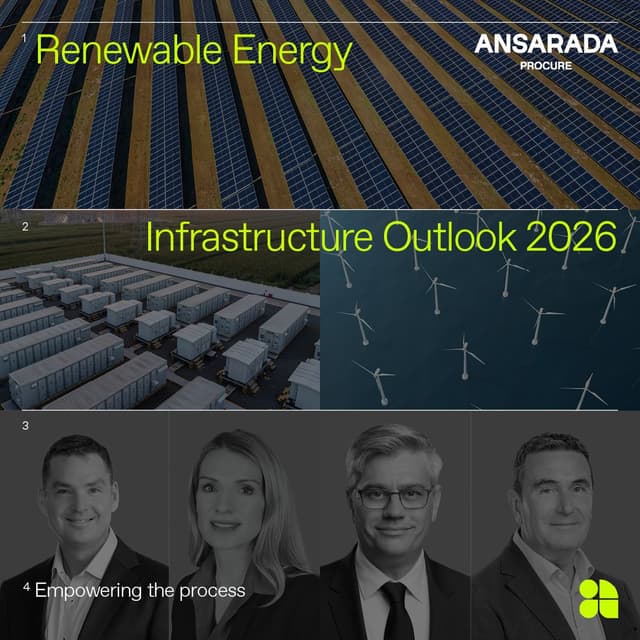
According to our 2026 Renewable Energy Infrastructure Outlook Report, developed in partnership with Infralogic, APAC is projected to more than double its total capacity by 2030 – positioning it to surpass the United States as the world's largest co-location market before the decade's end. The scale of this shift is extraordinary, but so are the execution challenges that could constrain it.
Record-breaking investment momentum
Asia recorded US$68.6 billion in renewable energy infrastructure investment in 2025, representing a 17% year-on-year gain. More significantly, transaction volumes surged by 31% to reach 316 transactions – the highest annual figures ever recorded for the region. This acceleration signals a fundamental reappraisal of APAC's role in the global energy transition, with international capital now treating the region as a primary deployment destination rather than an emerging opportunity.
At the forefront of this expansion is China, where actual deployment has dramatically outpaced even ambitious official projections. Authorities initially outlined plans to add more than 200 GW of new renewable capacity in 2025; the country added 310 GW in just the first nine months alone – a 47.7% year-on-year increase. Full-year projections have since been upgraded to approximately 400 GW of new capacity, cementing China's position as the engine of global renewables growth.
Policy innovation unlocking new markets
Beyond China's scale, policy innovation across the region is opening previously untapped opportunities. India has refined its framework, with the Ministry of Power introducing a national policy to promote pumped-storage projects and, for the first time, confirming viability-gap funding for initial offshore wind capacity. This represents a critical step in expanding India's renewable infrastructure beyond its traditional solar focus.
Japan's market evolution is equally significant. A recent amendment to marine legislation now allows offshore wind development within its Exclusive Economic Zone , opening substantial new areas for future projects. This regulatory shift addresses earlier challenges that had stalled large-scale schemes, dramatically improving the prospects for bankable offshore wind developments in Japanese waters.
The AI-driven energy imperative
What makes APAC's trajectory particularly compelling is the convergence of renewable energy deployment with surging AI compute requirements. The 2026 Renewable Energy Infrastructure Outlook Report reveals that 46% of APAC respondents identify rising energy demand as a top-two driver for new renewable infrastructure development – the highest rate globally. This reflects the region's position at the intersection of two transformative forces: the renewable energy transition and the exponential growth of artificial intelligence infrastructure.
Markets such as Malaysia and Australia face fewer legacy grid bottlenecks than their counterparts in North America or Europe, making them well-placed for the next generation of AI-ready renewable energy sites. The approval of New South Wales' US$3.1 billion CDC Data Centre campus at Marsden Park – designed to operate with nearly 99% renewable energy by 2030 – illustrates how APAC is positioning itself to capture this convergence.
Battery storage enters the mainstream
The maturity of APAC's renewable energy market is perhaps best illustrated by the rapid mainstreaming of battery storage. While 42% of global respondents forecast strong growth in battery storage, this figure rises to 62% in APAC, where large-scale deployment is already under way.
This shift reflects a sophisticated understanding that the region's renewable future depends not just on generation capacity, but on the firming infrastructure required to ensure grid stability and reliability.
Execution capability: the defining challenge
Despite this optimistic outlook, APAC faces distinct challenges that differentiate it from other global markets. Supply chain disruption emerges as the primary delivery risk, cited by 46% of APAC respondents. The region's vast geography compounds this challenge, with logistics constraints creating significant timing risks for multi-billion-dollar projects.
Procurement efficiency also lags behind other regions, with only 24% of APAC respondents describing their processes as very efficient – the lowest rate globally. This gap is closely linked to persistent interface friction and grid uncertainty across parts of the region, where projects are often brought to market before grid connection arrangements are fully resolved. As APAC accelerates its deployment, the defining challenge is no longer access to capital or policy support, but execution capability.
For investors, developers, and government agencies operating in this market, success requires not just financial resources, but the sophisticated coordination capabilities needed to navigate regulatory heterogeneity, manage extended supply chains, and deliver integrated projects that meet the exacting requirements of both traditional utilities and next-generation hyperscale compute facilities.
2026 Renewable Energy Infrastructure Outlook Report
In this report we assess the regions, sectors, drivers and challenges that will have the most impact on the renewable energy infrastructure market in 2026 and beyond.